
A woman sat across from me last year, convinced she was "a Fire person." She had taken an online quiz, gotten Fire as her result, and built an entire self-concept around it: passionate, charismatic, prone to burnout. She was confused because none of it fit. She was methodical. She preferred silence over crowds. She had held the same job for eleven years.
When I pulled her full chart, Fire was indeed her Day Master element. But her chart held almost no Wood to fuel that Fire, and three Metal characters were pressing down on it from every direction. Her Fire was not blazing. It was a pilot light under heavy regulation — controlled, precise, quietly persistent. The Metal surrounding her Fire made her a refiner, not a performer. And the Wood she lacked meant she rarely initiated anything on her own, instead excelling at perfecting what others started.
This is why element labels are useless without context. Saying "I am Fire" tells you almost nothing. Saying "I am a Yin Fire Day Master with dominant Metal in my Month Pillar and zero Wood across all four pillars" — that tells a story. That is saju.
If you are new to the system, start with what saju actually is. If you already know the basics, this is where the real mechanics begin.
The Engine Behind Every Chart
Most introductions to the Five Elements hand you a list: Wood equals growth, Fire equals passion, Earth equals stability. Personality types dressed up in elemental language. That approach misses the point entirely.
The Five Elements are not labels. They are an interaction system. The elements matter far less as individual qualities than as relationships — what feeds what, what restrains what, and what happens when the balance tips.
Two cycles drive everything in saju analysis:
The generating cycle, 상생 (sangsaeng), describes how each element produces and sustains the next. Wood feeds Fire. Fire creates Earth through ash. Earth compresses into Metal over time. Metal surfaces carry Water through condensation. Water nourishes Wood back to life. This is a closed loop of mutual support. When your chart has a strong generating sequence — say, abundant Water feeding a Wood Day Master that naturally produces Fire — energy flows without obstruction. Life feels like it has momentum.
The controlling cycle, 상극 (sangeuk), describes how each element keeps another in check. Wood breaks through Earth with its roots. Earth dams and redirects Water. Water douses Fire. Fire melts Metal. Metal cuts Wood. This cycle is not destructive by nature. It is regulatory. A chart needs controlling relationships the same way an ecosystem needs predators. Without Metal to prune Wood, Wood grows wild and directionless. Without Water to temper Fire, Fire consumes everything in reach and then starves.
These two cycles are the engine that powers every interpretation a practitioner makes. When I look at a chart, I am not cataloguing which elements are present. I am reading how they interact — where the generating sequences create flow, where the controlling sequences create pressure, and where breaks in either cycle create the specific patterns that define a life.
Wood (목/木)
Wood energy is directional. It pushes upward and outward with the same insistence that drives a root system through concrete. This is the element of directed growth — not growth for its own sake, but growth toward something. Wood without a target becomes restless. Wood with a clear direction becomes unstoppable.
The difference between Yang Wood (갑, 甲) and Yin Wood (을, 乙) is not a matter of degree. These are fundamentally different expressions of the same element. Yang Wood is the mature tree — vertical, principled, immovable in its convictions. A Yang Wood person will absorb enormous punishment rather than compromise on something they believe matters. They lead from the front, and their rigidity is both their greatest strength and the thing most likely to break them. Yin Wood is the climbing vine — adaptive, flexible, capable of finding indirect routes to the same destination. Where Yang Wood confronts an obstacle head-on, Yin Wood wraps around it, grows over it, finds the crack in the wall where light gets through. Both are tenacious. The tree is tenacious through endurance. The vine is tenacious through resourcefulness.
What matters most is what role Wood plays in your specific chart. Wood functioning as your 인성 (inseong, Resource star) means it represents your support system — mentors, education, the inherited knowledge that feeds your identity. Wood as your 재성 (jaeseong, Wealth star) means something completely different: it becomes the thing you must actively pursue and manage, the domain where effort converts to material result. Same element, opposite functions. A person whose Resource star is Wood finds nourishment through learning and intellectual growth. A person whose Wealth star is Wood finds prosperity through expansion, networking, and cultivating opportunities. The element is identical. The life implications are not.
Wood's shadow is not just "overextension," though that is part of it. The deeper failure mode is self-righteous inflexibility — the conviction that moral clarity justifies refusing to adapt. Yang Wood people in particular can build an identity so thoroughly around a principle that when reality shifts, they would rather shatter than bend. They mistake stubbornness for integrity. Yin Wood's shadow runs differently: the flexibility that makes them adaptive can curdle into manipulation, the vine that wraps around obstacles eventually wrapping around people.
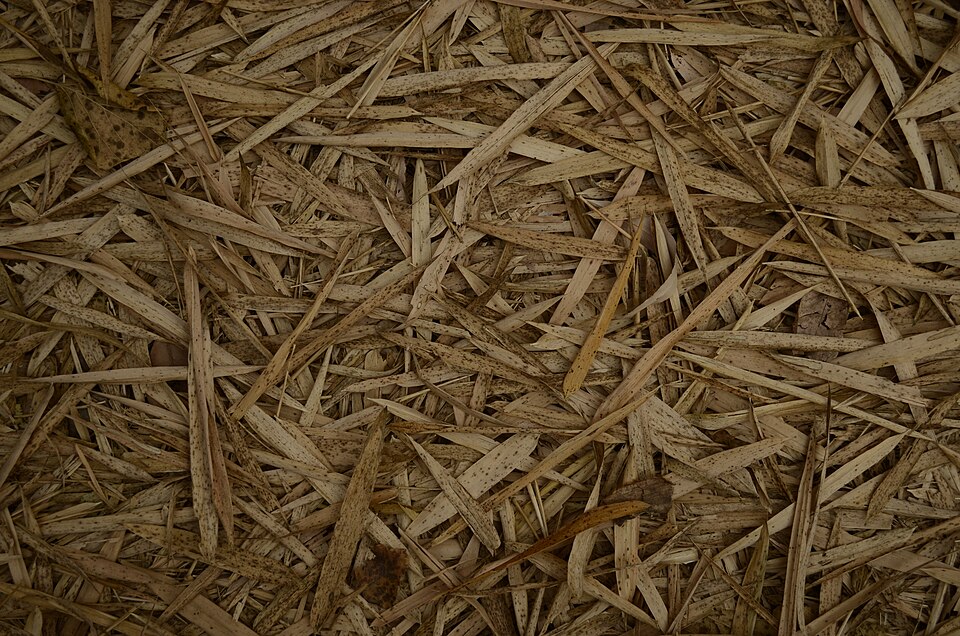
Bamboo forest. Wikimedia Commons, CC BY-SA 4.0
Fire (화/火)
Fire is the element of transformation and visibility. It does not simply exist — it radiates. Every other element can sit quietly in a chart. Fire announces itself. This is the energy that converts potential into expression, that takes the raw material other elements provide and makes it visible to the world.
Yang Fire (병, 丙) is the sun — generous, broad, illuminating everything around it with equal intensity. There is no selectivity in sunlight. Yang Fire people give warmth to everyone in range, and their presence changes the temperature of a room whether they intend it or not. Yin Fire (정, 丁) is the focused flame — a candle, a forge fire, a laser. Where Yang Fire broadcasts, Yin Fire concentrates. The Yin Fire person who turns their attention fully on you creates an experience of being seen that borders on uncomfortable in its precision. They illuminate what they choose, and what they choose to ignore stays in darkness.
Fire as your 비겁 (bigeop, Companion star) means you are surrounded by peers who match your energy — collaborative but competitive. Fire as your 식상 (siksang, Output star) means it represents your creative and expressive capacity, the channel through which your Day Master produces something tangible. Fire as your 관성 (gwanseong, Officer star) means it governs discipline, authority, and the external structures that regulate your life. A Water Day Master with Fire as their Officer star faces a particular tension: the element that controls them is also the element that gives them professional structure. The constraint is the career.
Fire's real shadow is not burnout, though burnout is the visible symptom. The deeper pattern is dependency on external validation. Fire needs to be seen the way a flame needs oxygen. Cut off the audience, remove the recognition, and Fire does not quietly persist. It either flares desperately — escalating, dramatizing, creating crises that force attention — or it extinguishes entirely into withdrawal so complete that people who knew the person before barely recognize them. There is rarely a middle ground.

Campfire flames. Wikimedia Commons, CC BY-SA 3.0
Earth (토/土)
Earth is the only element that does not belong to a single season. It governs the transitional periods — the eighteen days between each seasonal shift when one energy is fading and the next has not yet arrived. This positioning tells you everything about Earth's nature. It is the element of integration, the medium through which every other element must pass during transformation. Earth does not lead change. It metabolizes change so that the system can keep functioning.
Yang Earth (무, 戊) is the mountain — massive, immovable, defining the landscape around it by sheer presence. People build against a Yang Earth person the way settlements form in the shelter of a mountain range: for protection, for permanence, for the assurance that something in the world is not going to shift. Yin Earth (기, 己) is cultivated soil — receptive, fertile, quietly capable of transforming whatever is planted in it into something living. The mountain impresses through scale. The garden impresses through what it produces.
Earth's role in a chart shifts its meaning dramatically depending on its 십성 (sipseong, Ten Gods) assignment. Earth as your 인성 (Resource star) makes stability itself your source of nourishment — you are fed by routine, by familiar ground, by the act of maintaining what already exists. Earth as your 식상 (Output star) means your creative expression takes the form of building, organizing, and creating systems that hold other things together. Earth as your 재성 (Wealth star) means material security comes through property, through stewardship, through managing tangible assets. The practitioner who ignores these distinctions and simply says "you have a lot of Earth, so you are stable" is giving you a horoscope, not a reading.
Earth's shadow is not mere stubbornness, though it presents that way. The real failure pattern is accumulation without release. Earth absorbs — problems, obligations, other people's emotional weight, responsibilities that were never theirs to carry. And unlike Water, which eventually overflows, Earth just compresses. The anxiety builds silently. The resentment layers. The mountain looks solid right up until the landslide. Earth people rarely signal distress because signaling distress feels like admitting the foundation is cracked, and if the foundation cracks, everything built on top of it comes down.
Metal (금/金)
Metal is the element of refinement and separation. Where Earth integrates, Metal differentiates. It is the energy that distinguishes what is essential from what is excess, that cuts away everything that does not serve the final form. This is not an aggressive energy, despite how it sounds. A surgeon's scalpel is Metal energy. So is the editorial instinct that removes three paragraphs to make an essay land. Metal serves precision.
Yang Metal (경, 庚) is raw ore, the unrefined blade — powerful, direct, capable of reshaping situations through force of will. Yang Metal people are blunt in ways that other elements find either bracing or unbearable, depending on their own constitution. There is no subtext with Yang Metal. What you see is the full message. Yin Metal (신, 辛) is the cut gemstone — formed under pressure, beautiful, and possessing an edge that is easy to miss beneath the polish. Yin Metal people feel things with a sharpness they rarely display. Their precision comes from sensitivity compressed into something harder, the way carbon becomes diamond only under conditions that would destroy softer materials.
Metal functioning as your 관성 (Officer star) means structure and discipline arrive through cutting, through elimination, through saying no. Metal as your 비겁 (Companion star) means your peer group operates on standards and mutual accountability — relationships built on respect rather than warmth. Metal as your 인성 (Resource star) means you are nourished by clarity, by frameworks, by the act of understanding how things are properly structured. Each of these produces a completely different life experience, despite the element being the same.
Metal's shadow goes beyond harsh criticism, though that is the surface expression. The deeper pattern is emotional isolation disguised as self-sufficiency. Metal people construct such effective boundaries that they eventually trap themselves inside them. The loyalty they are capable of — and Metal loyalty, once earned, is absolute — becomes invisible because they cannot express it in terms that softer elements recognize. They show love through acts of protection and correction, and when that language goes unrecognized, they do not switch to a different one. They withdraw further, convinced that the problem is other people's weakness rather than their own inability to translate.
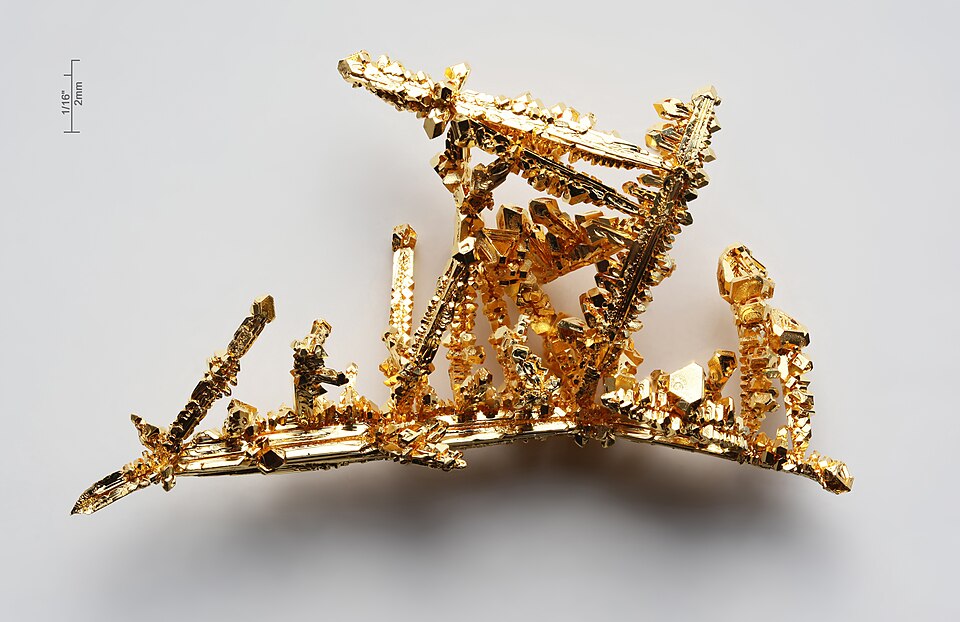
Gold crystals. Wikimedia Commons, Public Domain
Water (수/水)
Water is the element of depth and movement. It flows downward, seeks the lowest point, fills every available space, and finds routes that no other element would consider. This is the energy of perception — not the broad illumination of Fire, but the deep, penetrating awareness that maps what lies beneath surfaces. Water perceives what is hidden. This makes it indispensable and dangerous in equal measure.
Yang Water (임, 壬) is the ocean — vast, tidal, operating on rhythms that are invisible from the shore. Yang Water people think in systems and long cycles. Their apparent calm is not passivity; it is the surface of something so deep that most of its movement happens where no one can see it. When Yang Water finally acts, the scale tends to surprise people who mistook stillness for absence. Yin Water (계, 癸) is rain and morning dew — quiet, persistent, arriving exactly where it is needed with a consistency that borders on eerie. Yin Water people influence through accumulation rather than force. A single drop does nothing. Ten thousand drops reshape stone.
Water as your 인성 (Resource star) means your nourishment comes through contemplation, through absorbing information, through the slow accumulation of understanding that eventually reaches a tipping point. Water as your 재성 (Wealth star) means prosperity flows through adaptability, through reading currents and positioning yourself where opportunity is about to arrive. Water as your 관성 (Officer star) means the structures governing your life are fluid rather than fixed — your career and social role shift and adapt, which can feel like freedom or instability depending on the rest of the chart.
Water's shadow is not just anxiety, though anxiety is the most visible symptom. The core failure pattern is perception without resolution. Water sees everything — every risk, every hidden motive, every possible outcome branching into further outcomes — and the seeing never stops. Other elements can close a door on a problem and walk away. Water cannot stop knowing what is behind the door. This produces paralysis in decision-making, chronic overthinking that devours energy, and a tendency toward secrecy that damages trust. The Water person who uses their perceptive gifts to manipulate rather than to understand has access to a particularly corrosive form of power, because they always know exactly where the vulnerability is.

Ocean waves. Wikimedia Commons, CC BY-SA 4.0
Position Changes Everything
A common mistake — one that most online element descriptions reinforce — is treating elements as fixed qualities. "You have a lot of Fire, therefore you are passionate." That is not how chart reading works.
The same element means different things depending on where it appears in your four pillars. Fire in your Month Pillar (월주, wolju), which governs career and social identity, points toward a professional life driven by visibility, expression, and public-facing work. Fire in your Hour Pillar (시주, siju), which governs your inner world and legacy, suggests something entirely different: a private intensity, a creative inner life that may never become publicly visible, a relationship to your own children or creative output that carries Fire's transformative quality.
This is also where the concept of 용신 (yongsin, the beneficial element) and 기신 (gisin, the unfavorable element) reshapes everything. Your 용신 is the element your chart needs most — the correction that brings balance. Your 기신 is the element that pushes an existing imbalance further out of alignment. The same element can serve either function depending on the chart.
Consider two people who both have strong Metal in their charts. For a Wood Day Master, that Metal is likely 관성 — the Officer star — and if the chart is already heavy on controlling energy, more Metal becomes 기신. It is pressure on top of pressure, discipline without relief. For a Water Day Master, that same Metal is likely 인성 — the Resource star — and if the chart lacks nourishment, Metal becomes 용신. Same element, opposite prescriptions. One person needs to avoid Metal-heavy environments. The other person needs to seek them out.
Then there is the question of absence. Having zero percent of an element in your chart is not a catastrophe, but it is not nothing either. A chart with no Water at all tends to produce a person who struggles with emotional depth and strategic patience — not because they are incapable of these things, but because the chart provides no natural support for them. They have to build those capacities consciously, often by surrounding themselves with Water-heavy people or entering Water-dominant luck cycles. A chart with no Earth often shows up as difficulty with stability and follow-through: brilliant starts, weak middles, and a pattern of rebuilding from scratch that repeats across decades.
The Cycles in Practice
Theory is useful. Application is what separates a practitioner from a textbook.
Here is how the generating cycle (상생) works in real analysis. Take a chart with a Fire Day Master, abundant Wood, and moderate Earth. Wood feeds Fire. In this chart, that means the person's Resource element naturally fuels their core identity — they have deep reserves to draw from. Education, mentorship, inherited knowledge: all of it converts efficiently into personal power. The Fire then generates Earth, meaning their creative output and self-expression (Fire) naturally produces tangible, stable results (Earth). This is a chart that converts learning into doing into building, with each stage feeding the next. The sequence has momentum.
Now break one link in that chain. Same Fire Day Master, but remove the Wood. Now Fire has nothing feeding it from behind. The person still has Fire's qualities — expressiveness, visibility, warmth — but the fuel supply is unreliable. They burn bright in bursts and then go dark while they scramble for nourishment that does not arrive naturally. Their career might show this pattern: intense periods of productivity followed by extended recovery phases that confuse employers and partners alike.
The controlling cycle (상극) operates with equal specificity. A Metal Day Master with strong Fire in the chart faces constant refinement — Fire melts Metal, and in chart terms, this means the person's Officer star (the element that governs discipline and external authority) is actively reshaping them. If the Fire is moderate and well-placed, this produces someone who accepts structure and grows under pressure. If the Fire is excessive and the Metal is already weak, the person feels crushed by external expectations, constantly reshaped by forces they cannot resist. Same mechanical interaction, different proportions, different life.
The most interesting charts contain both generating and controlling relationships in tension. A Wood Day Master with strong Water (generating — Water feeds Wood, providing deep resources) and strong Metal (controlling — Metal cuts Wood, imposing constant pruning) lives in a state of simultaneous nourishment and restraint. They are fed and cut at the same time. This kind of chart produces people of unusual depth: individuals who grow relentlessly but are equally relentlessly edited by circumstance, resulting in a precision of character that neither cycle alone would produce.
This is why a full chart reading matters more than knowing your element. The elements are the vocabulary. The cycles are the grammar. The chart is the sentence. And like any sentence, the meaning depends on which words are next to each other.
You Might Wonder
Does everyone have all five elements?
Your chart contains eight characters across four pillars, and each character carries elemental energy. Most charts contain three to four of the five elements in varying proportions. Having all five is relatively common. Having only two is rare but not unheard of. The distribution, not the presence, is what drives the analysis.
What does a missing element actually mean in daily life?
A missing element creates a gap that the chart cannot fill internally. In practice, this means you tend to attract that element through external sources — partners, career environments, geographic locations. A chart with no Metal might consistently attract Metal-heavy partners or gravitate toward careers that demand Metal qualities like precision and structure. This is not mystical attraction. The chart has an imbalance, and the life compensates. Understanding which element is missing gives you clarity about why certain patterns keep repeating.
Is there a strongest or best element?
No. The Five Elements form a cycle of mutual generation and mutual control. Each one feeds one element and restrains another. A chart overloaded with any single element is not strong — it is imbalanced. A chart that is eighty percent Metal is rigid and cutting. A chart that is eighty percent Water is drowning in perception with no capacity for action. Strength in saju comes from the quality of relationships between elements, not from the volume of any single one.
How do I find out what my chart actually contains?
You need your full birth data: year, month, day, and ideally the hour. Each of your four pillars contains a Heavenly Stem and an Earthly Branch, and the Branches contain hidden elements that are not visible from surface-level analysis. A proper reading maps the full distribution — including those hidden elements — and, more importantly, interprets how they interact.
Do my elements change over time?
Your birth chart is permanent — it is a snapshot of the moment you arrived. But your 10-year luck cycles (대운, daewun) bring different elemental energies into prominence at different life stages. A Wood person entering a Metal-dominant luck cycle will feel the pruning whether they are ready for it or not. Understanding which elemental energy is arriving — and whether it functions as 용신 or 기신 for your specific chart — is what turns saju from a personality description into a timing tool.
If I know my Day Master, do I really need to know all this?
Your Day Master is the starting point, not the conclusion. Knowing your Day Master without understanding the elemental relationships in your chart is like knowing your name without knowing your address, your job, or who you live with. The Day Master tells you what kind of energy you are. The Five Elements and their interactions tell you what kind of life that energy is navigating.
Want to find out which element drives your chart? Take the free quiz — it takes 10 seconds.